← All work
LPL Financial · ClientWorks
Senior Product Designer
Fintech / Enterprise
One way to move money, across every account type.
LPL's Move Money systems were outdated, inconsistent, and error-prone, with a different experience for every transaction type. I designed a unified flow across trust and retail accounts, integrating trust data into ClientWorks and automating the manual steps that slowed institutional users down.
RoleSenior Product Designer
Team3 · Design + partners
ToolsSketch · Miro · InVision
DomainACH · Wires · Checks
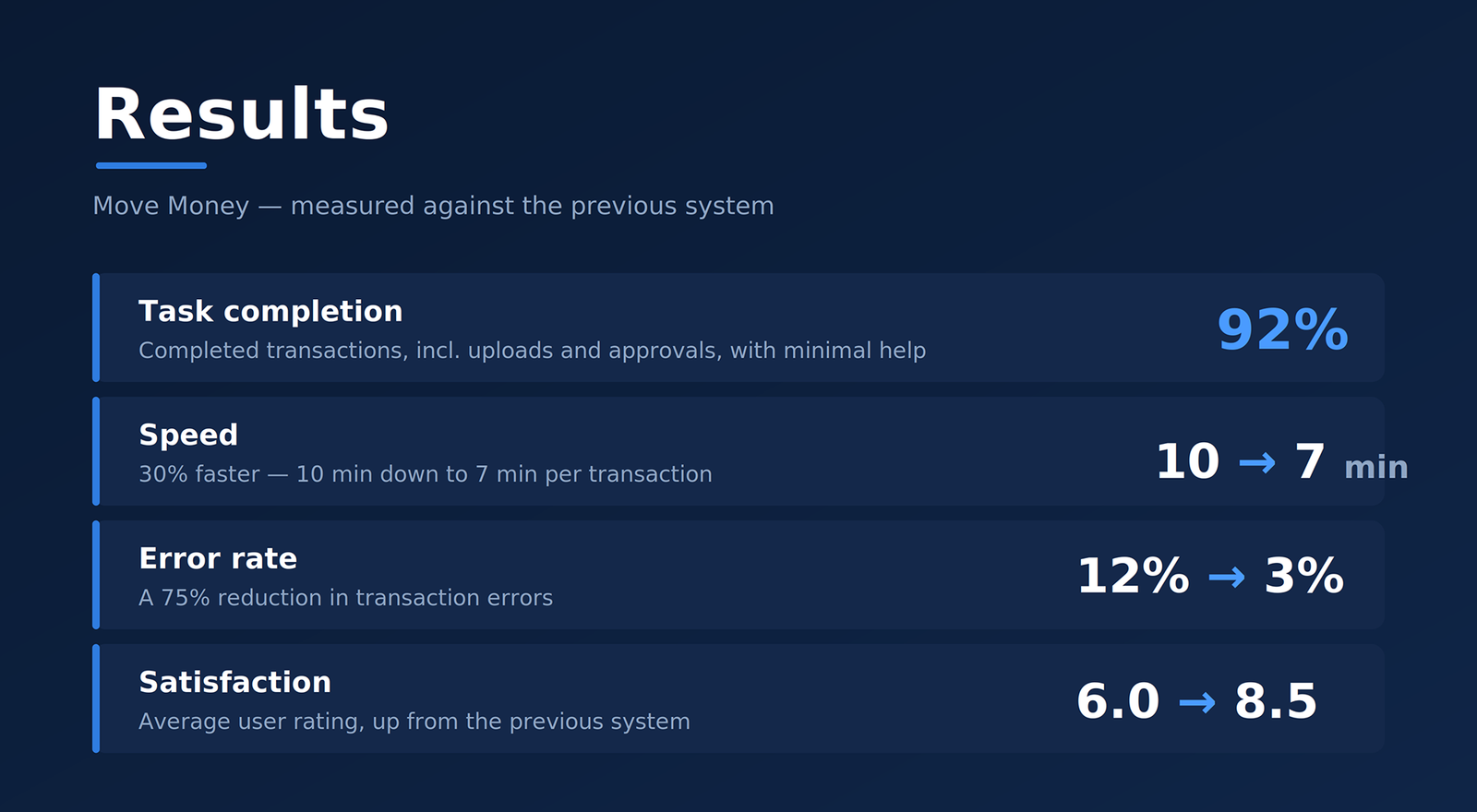
3→1
transaction types, one unified flow
12
institutional users tested with
↓
manual data entry & errors (add figure)
↑
workflow satisfaction (add figure)
01 / Context
A unified platform needed a unified transaction
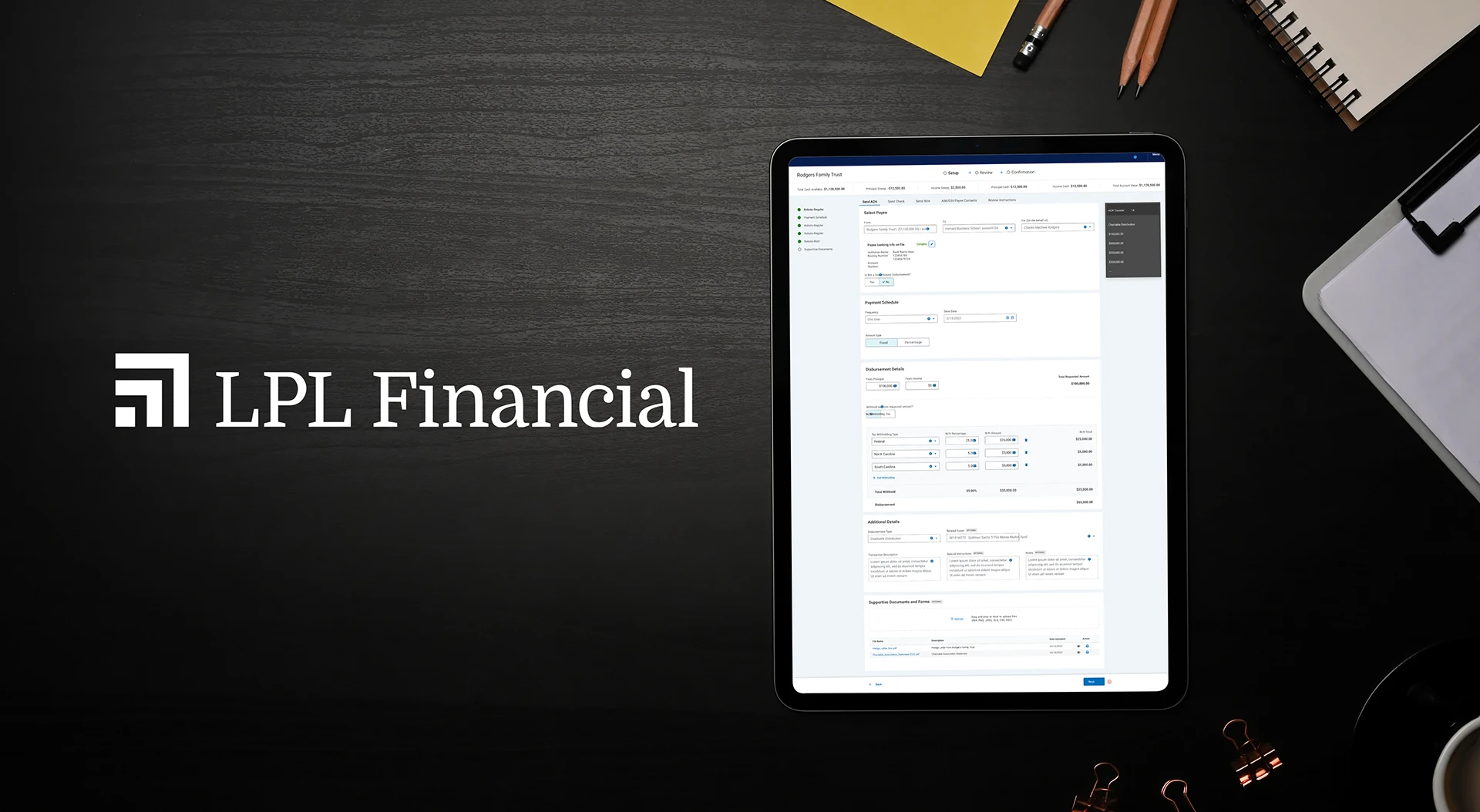
LPL Financial was building toward a single wealth platform, but its Move Money systems worked against that goal: outdated, complicated, and different depending on the account. To bring trust accounts into the fold, LPL partnered with Fi-Tek, a trust-accounting provider, and built a Bank Trust System of Record as the integration foundation, letting data flow across the LPL ecosystem.
My job was the experience layer on top: a consistent, efficient Move Money flow that worked the same across all account types, with document uploading, process automation, and clean backend integration.
02 / The problem
Fragmented, manual, error-prone
Institutional users, trust officers, investment officers, operations managers, juggled account types through a process that fought them at every step. I framed it as one question:
"How do we make Move Money consistent and efficient across every account type, without breaking the workflows institutional users already rely on?"
Discovery, stakeholder interviews, workshops with financial experts, and a review of user feedback, surfaced the recurring failures:
- Inconsistent experiences across ACH, Wires, and Checks.
- No clear guidance or useful error messages mid-transaction.
- Outdated systems forcing constant back-and-forth between departments.
- Manual data entry that invited costly mistakes.
- No automation for routine steps like document upload and approvals, dragging out transaction times.
03 / Users
Four people, four kinds of pressure
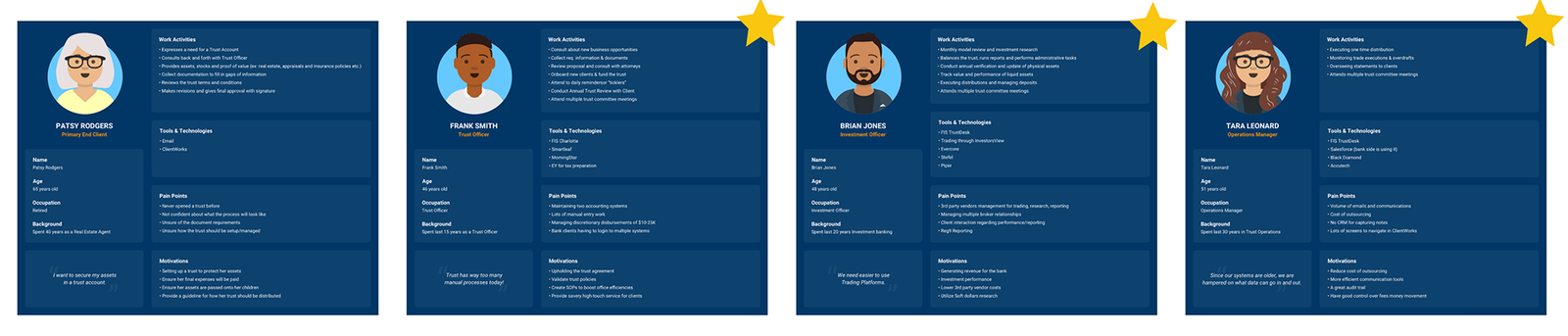
Patsy Rodgers
Philanthropic client · 62
Manages a family trust and makes regular donations. Comfortable with basics, lost in jargon. Wants a hassle-free distribution without calling support.
Frank Smith
Trust officer · 45
20+ years processing trust accounts. Meticulous and compliance-driven. Wants accurate requests with minimal cross-system back-and-forth.
Brian Jones
Investment officer · 38
Initiates money requests as part of broader strategy. Tech-savvy; frustrated by switching between systems that break his flow.
Tara Leonard
Operations manager · 50
Approves and executes trust requests. Wants streamlined decisions, clear action items, and confidence that everything is compliant.
04 / Pain points
Where the current flow broke down
Interviews mapped each persona's friction to a specific failure:
- Patsy, technical jargon and unclear instructions forced her to call support for basic transactions.
- Frank, manual, non-standard request forms across account types wasted time and bred errors.
- Brian, tracking transactions meant hopping between systems, breaking his workflow.
- Tara, an approval process with no automation and no clear action items created delays and manual verification.
05 / User flows
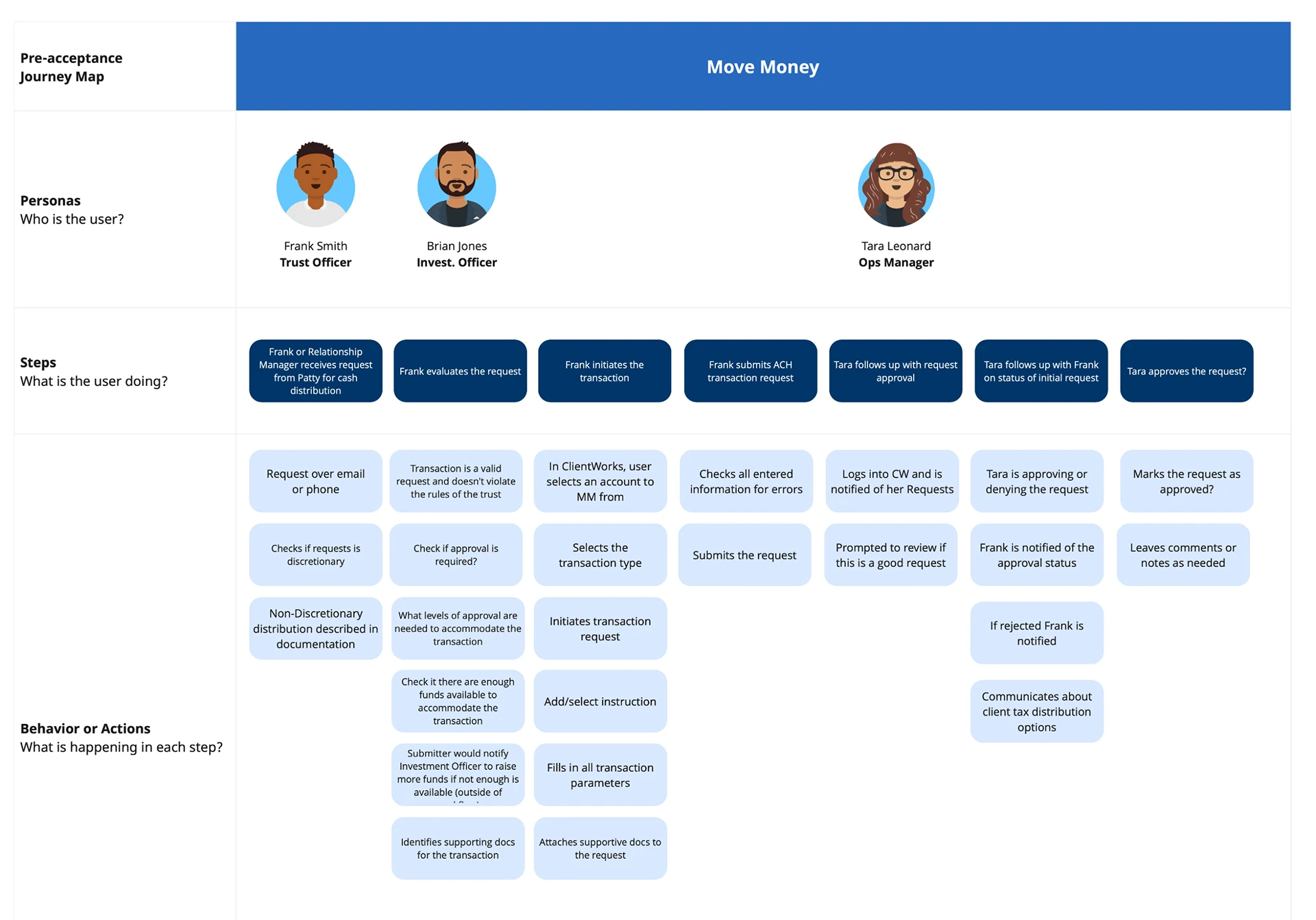
One consistent path per transaction
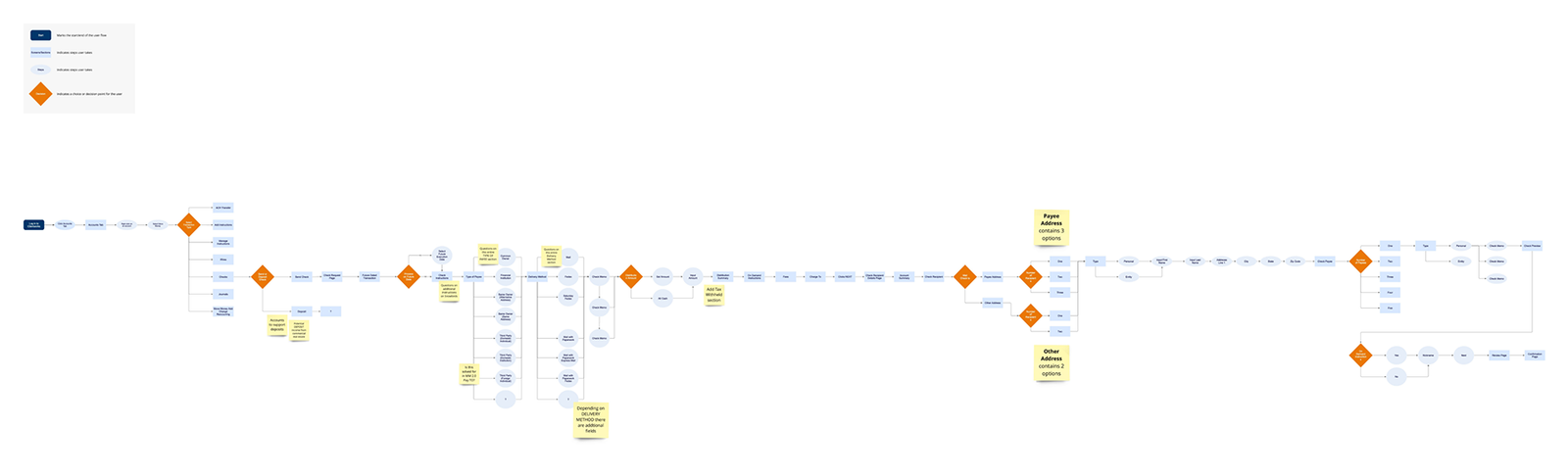
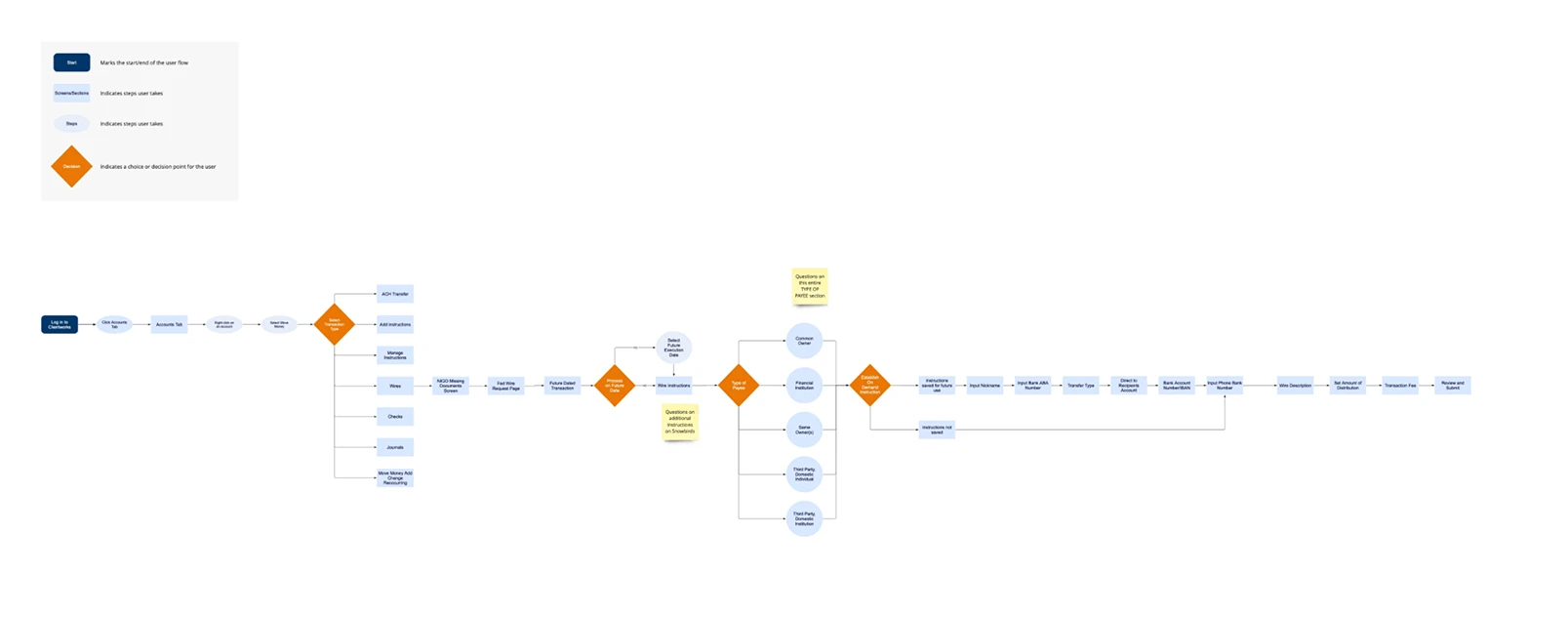
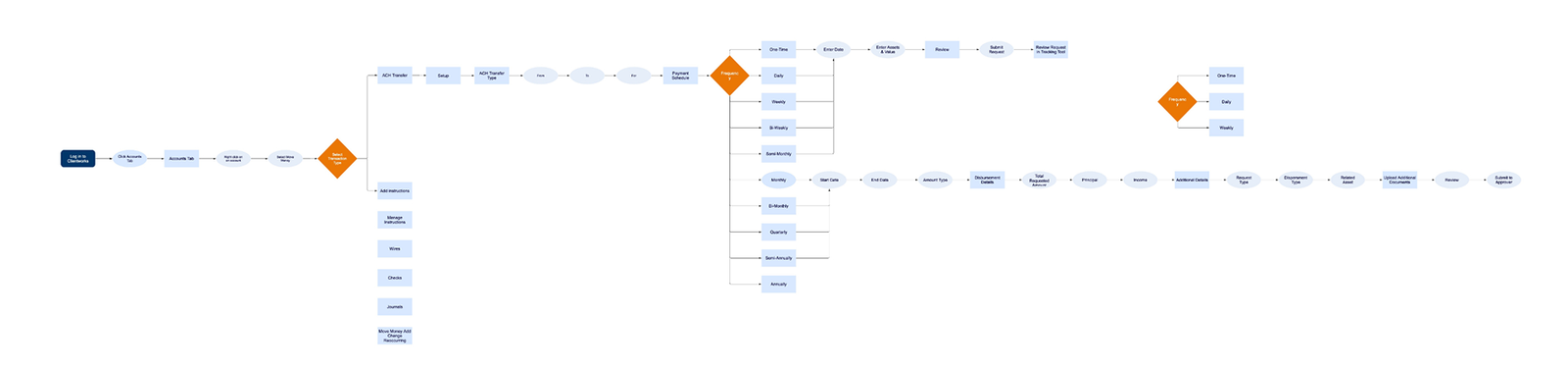
I rebuilt the flows for ACH, Wires, and Checks around a shared spine: clear instructions, helpful error messages, and confirmation screens at each step. Same mental model, whatever the transaction, so an institutional user learns Move Money once, not three times.
06 / Design
Wireframes that reuse what already works
I designed a unified Move Money experience that spanned all account types while streamlining the business process and integrating document upload and storage. Rather than reinvent, I reused existing retail modules and extended them to trust, giving trust, retail, and institutional users one coherent product, and giving engineering a build that leaned on proven components.
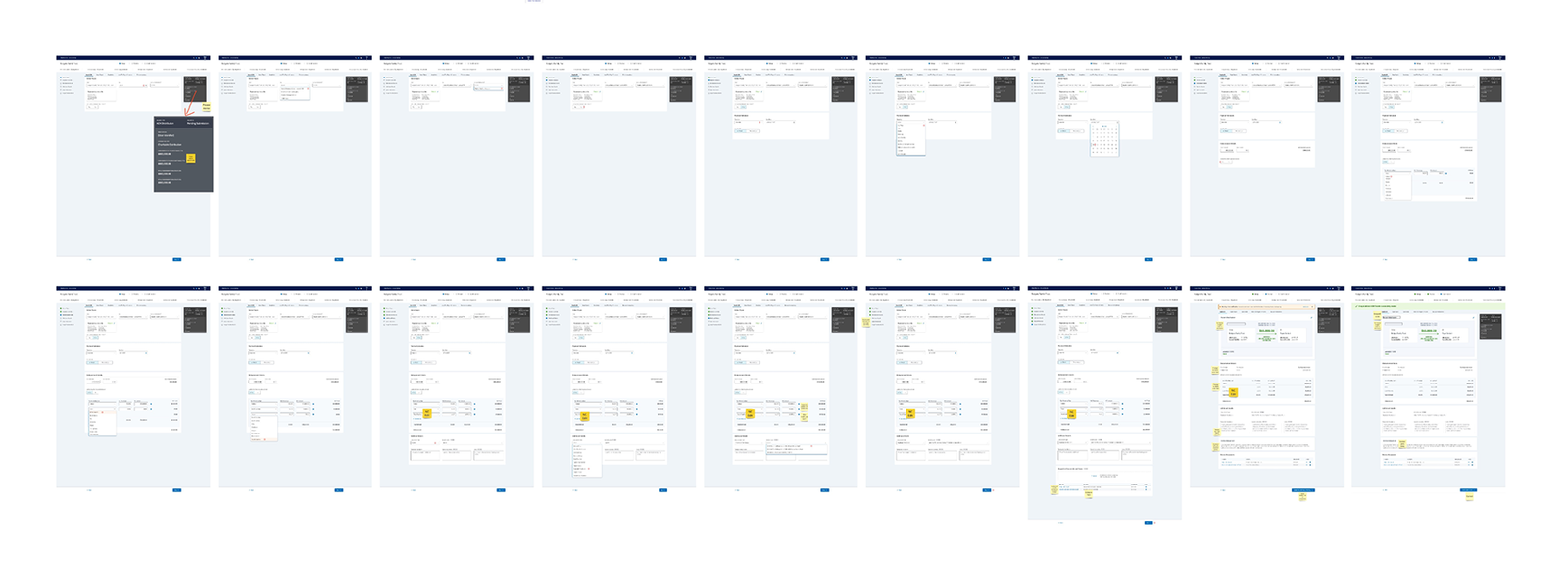
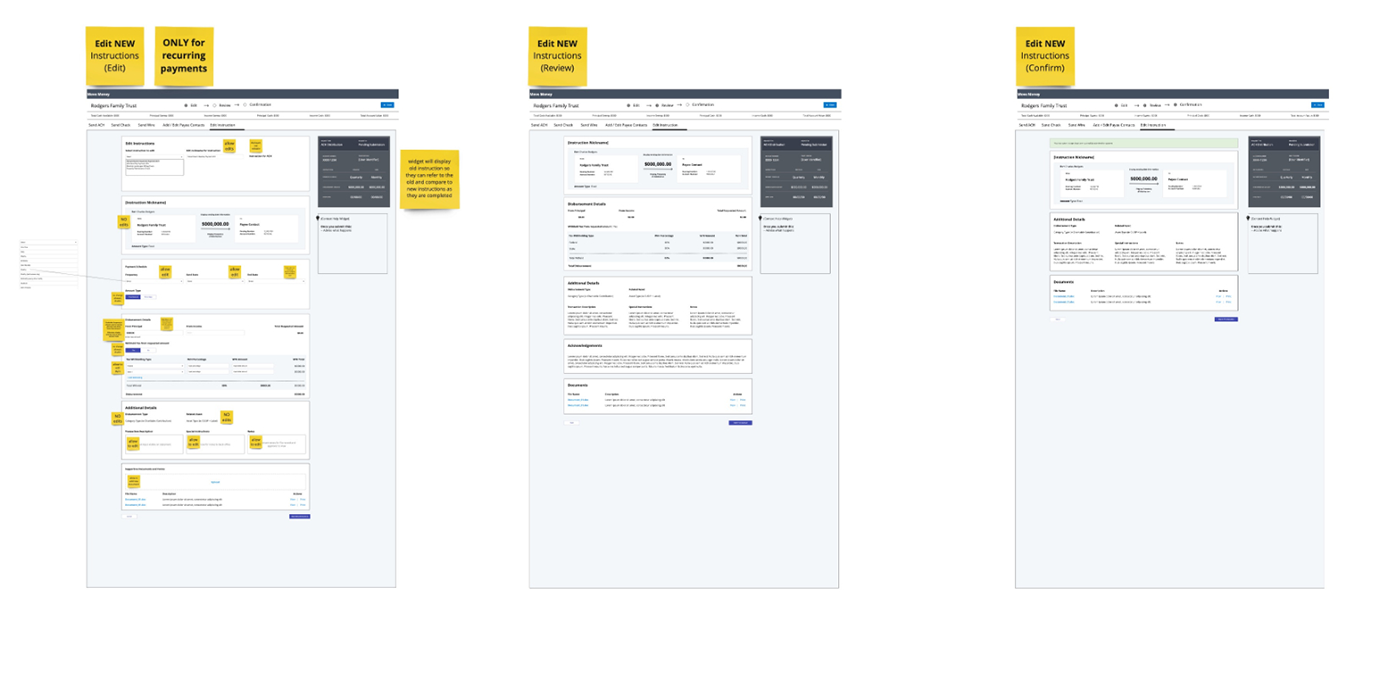
Mid-fi: the unified flow end to end, and the annotated review passes that shaped it.
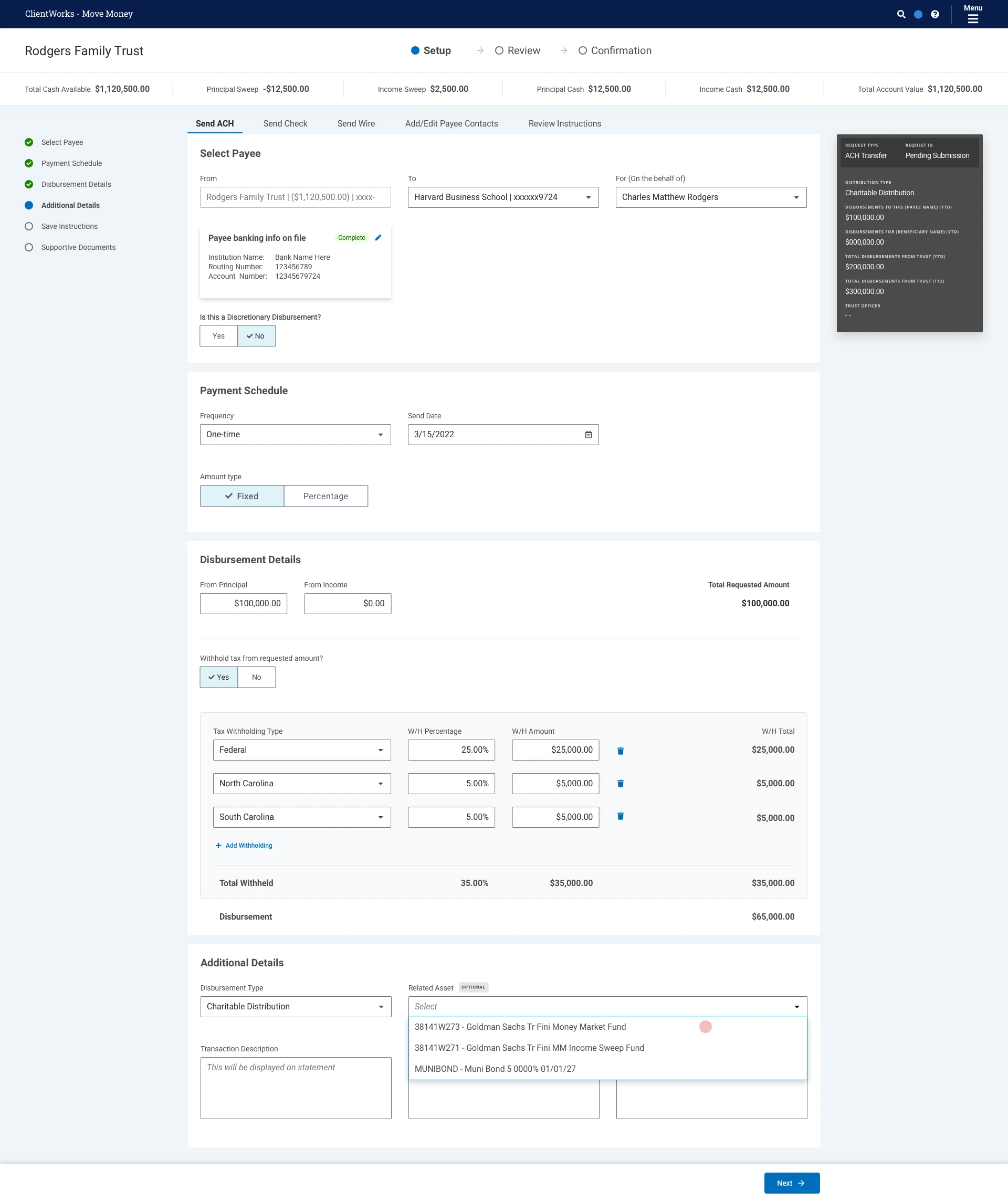
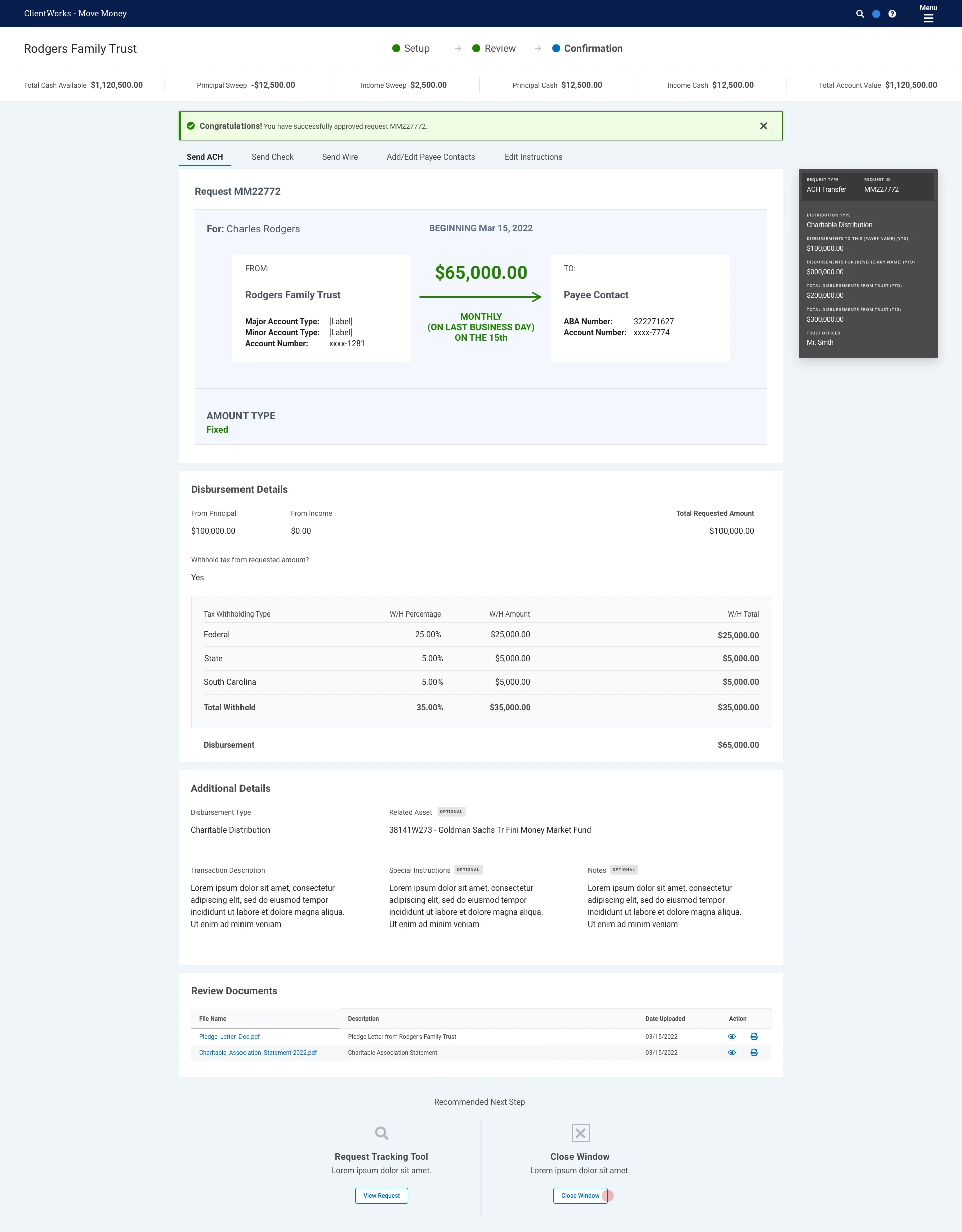
Hi-fi: one form for every transaction type, and a review screen that confirms before anything moves.
07 / Validation
Testing with the people who'd live in it
Using UserTesting.com and pilot focus groups, I tested with 12 institutional users, product managers, software users, and bank officers. Feedback concentrated on registration, data mapping, and integrating the unique data points that trust business demands. Each round of results fed a wireframe iteration, tightening the flow toward something that fit how these users actually work.
08 / Outcome
A single Move Money experience
Integrating trust data into ClientWorks gave institutions one view across trust and retail. The Move Money interface handled multiple transaction types, starting with ACH and a discretionary approval workflow built for trust, on top of a unified flow with three concrete wins:
- Unified experience, institutional and retail users share one workflow.
- Process automation, document upload and storage streamlined, cutting manual steps.
- Backend integration, Fi-Tek's trust systems connected so data moves cleanly across touchpoints.
Note to self: add real impact figures here if available, reduction in transaction time, drop in data-entry errors, support-call volume, or adoption across trust officers. This is the section a fintech hiring manager will scan first.
09 / Reflection
What I took from it
In regulated financial products, consistency isn't a style preference, it's risk reduction. Every place the old flow diverged between ACH, Wires, and Checks was a place an operations manager could make a costly mistake. Unifying the experience wasn't about elegance; it was about removing the seams where errors hid.
The other lesson was leverage: the fastest path to a trustworthy trust experience was reusing the retail modules users already trusted, then extending them, not designing a parallel system. Meeting engineering where they already had proven components got a safer product shipped faster.